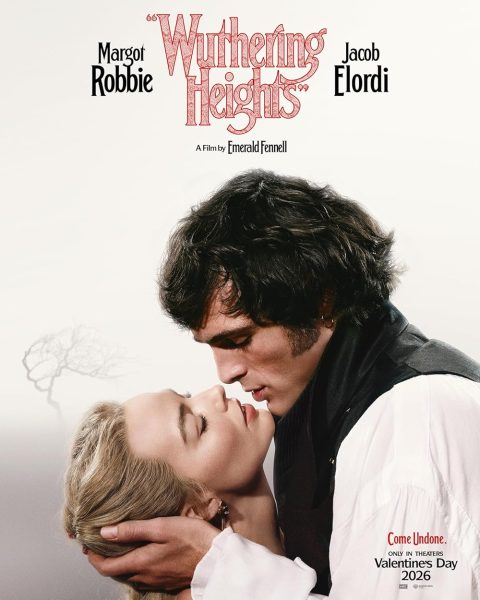
Movie theaters are a constant rotation of people scanning tickets, getting in line for their buckets of popcorn, spilling kernels as they rush into their auditoriums, anxiously awaiting the start of their films. But on Friday, Feb. 20, an explicable lull fell over Regal Greenway Grand Palace Movie Theater. Workers gathered around the checkout counter, marveling at the take-out a concessionist had ordered to the theater. “You always get Chinese food,” his coworker marveled, her laugh blending with the sounds of Bruno Mars’ “That’s What I Like” playing softly over the speakers. The air smelled faintly of butter and sugary ICEE’s that faded slightly going down the escalator. I see the “Wuthering Heights” poster shining above auditorium eight as I step into the theater. As the previews came to a close, I nestled into my seat as the opening shot of “Wuthering Heights” lit up the screen.
Emerald Fennell’s “Wuthering Heights” stirred controversy after some viewers have criticized it for straying far from the original source material: Emily Brontë’s beloved novel that has maintained its popularity since its original release in 1847.
Senior Avery Hildreth had conflicting thoughts after enjoying both the book and movie. “I don’t think Emily Brontë would approve.” Aesthetically, she was attracted to the “artistic vision” for the film. But, ultimately she left the theater with a sense of confusion, unable to balance the authenticity of Victorian England with the contemporary soundtrack and costuming. “It was quite literally the worst and best movie I’ve ever seen in my entire life at the same time.”
Many share Hildreth’s sentiment, including senior Darcy Sabloff. “It was more of a fanfic adaptation, than an actual adaptation. Jacob Elordi was not supposed to be white. Sure you can be creative, but it wasn’t accurate to the book.”
However, a myriad of viewers, including upper school social sciences teacher Holly Daniel, appreciated the movie’s heartfelt message and time period inclusions. “I actually think it was a pretty good representation of the choices women had to make. The depiction at the time is that she’s got to marry. She’s not gonna go to college, and go get a career, and get a job. It’s up to her to increase her status through men and her sexuality.”
Despite the turmoil among the literary and film enthusiast communities, the film boasts incredible box office success. According to The Hollywood Reporter, the film grossed over $83 million globally on its opening weekend.
As the lights came up in the theater, the audience stirred awake. Recovering from a tragic ending, a teenage girl sobbed from the front row, rubbing her face roughly with her sweatshirt sleeve. A couple near the projector in the back chattered excitedly, dissecting the film’s complex metaphors. And an older woman sitting to my right, wearing a thick knit sweater giggled excitedly with her friends, inviting me to join her conversation. “I can’t wait to read the book now!”