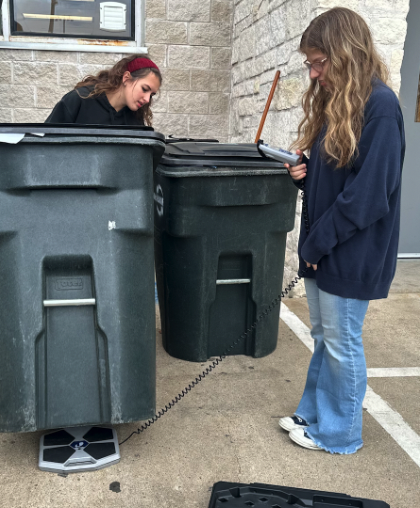
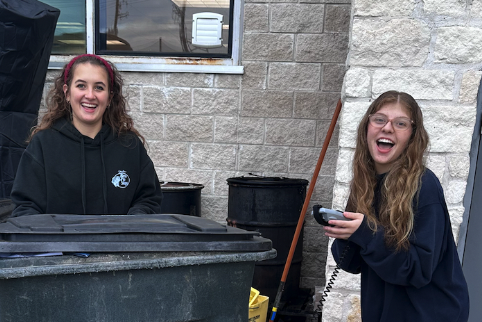
While The Emery/Weiner School has no doubt seen many new additions to campus this year, including an entire new building and a multitude of student study spaces, every classroom now sports a bright recycling bin.
The Jewish idea of tikkun olam, or the human obligation to repair the world, is baked into the foundation of Emery. From campus-wide service events to an entire school club dedicated to tikkun olam, students are no stranger to taking action to benefit the world. So, when a couple of environmentally conscious students wanted to bring recycling to Emery, the community made it happen.
While Emery had an environmental club, for the past couple years it had seen a decline in membership but not for lack of interest in environmental action. So, the establishment of the Environmental Action Club (EAC) at Emery is exciting news for everyone on campus. Its board consists of all current seniors; co-presidents, Madison Cox, Eliot Kelly-Leftwich, Carolina Luna Giorgi, and secretary Ryan Brooks. Mr. Walker Fair, technical director for the theatre program, has always been passionate about the environment. From an extensive water collection system at his house to his work in the solar panel industry, he became a mentor for students that wanted to help Emery recycle.
In the 2024-25 school year Cox, Kelly-Leftwich, and Luna Giorgi, “approached me in my temporary facilities role, and said we want to bring recycling to this campus,” recounts Fair.
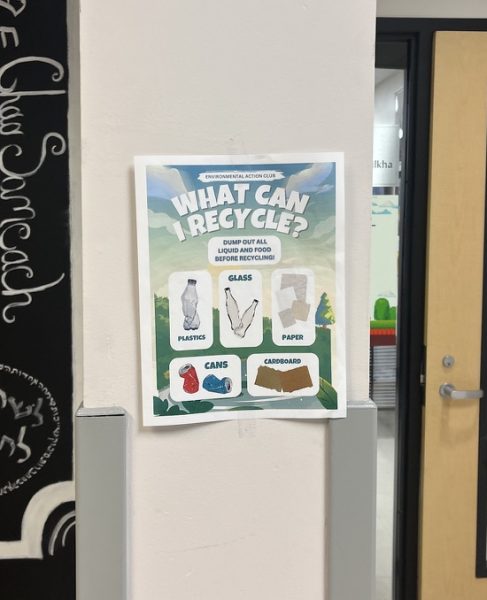
While Emery investigated several companies that could help the school start recycling, most companies required all recycled material to be uncontaminated. Contamination of material can be caused by many factors, including well-meaning people that are unaware of the types of materials that can be recycled. The EAC knew that in order to bring recycling to school, they were going to have to spread awareness and try to find a more understanding company. “Even if someone threw a can with a quarter inch of Coke into the recycling, which soaks into all the papers, and which the recycling company notices, then everything is thrown away and they fine us,” reveals Fair. The company that Emery now uses, Mission: Recycle, hand sorts all material, meaning contamination is less of a barrier to recycling. (https://www.mission-recycle.com/) Motivated, EAC members organized bins in every classroom and put up posters around the school with helpful diagrams of what goes where.
Recycling bins tend to fill up quickly, a testament to how receptive the community is to this effort. However, it also brought up a new question: who will empty the bins? Currently, EAC members make weekly rounds throughout the SEC and Upper School buildings, collecting recycling to bring to a central bin for pickup. The middle school student government association has even become involved and are now responsible for organizing pickup throughout middle school classrooms. The EAC also gives huge thanks to the facilities teams for help from facility access to industrial scales and recycling bins.
While recycling is a new win for the EAC at Emery, they are always looking to the future. Moonshot Compost has started compost collection in the kitchens, and ideas about switching to compostable plates and utensils have been brought up. In November, Emery collected 1,052 pounds of compost and since it has been implemented, 6,139 pounds. Conversations about solar panels and ways to make the new SEC addition to campus more green are in the future, all an indication of what can come when students are passionate for environmental change.
Recycling, composting, and awareness are huge successes for EAC at Emery, but doubt rises when the scope of climate change is considered. Some students feel that their individual actions do not have a chance of making an impact. While climate change is a vast and complex issue, anything that can be done to make an impact does in fact help. In mid-October, the EAC recently joined Adamah, a Youth Jewish Climate Movement group. Adamah embodies the same values of tikkun olam that is at the heart of Emery. Their mission, is “make taking collective action towards climate justice a central, defining feature of what it means to be Jewish over the next decade, empowering the next generation of Jewish youth to be leaders in our fight to build a sustainable and equitable world for all.” Cox believes that by becoming part of this North American environmental organization, gives credibility and reassurance to Emery’s efforts. If schools across the world take steps like Emery has, the impact would be undeniable. (https://adamah.org/for-teens-youth-adults/jewish-youth-climate-movement/)
Even if you’re a student at Emery that is not involved in the club, or simply appreciates being able to recycle your notes like me, Cox reminds everyone that they can make an effort and that “even becoming more conscious of your everyday behaviors has an effect.” Whether that is shopping more sustainably for clothing or opting for reusable products, we can all make an effort to support environmental action not just at Emery, but throughout the world. Luna Giorgi agrees that it is so easy to take action. “I think being aware of it is so important. Opportunities fall into your lap all the time, like maybe I’ll walk to my friend’s house instead of driving, or buy this recyclable bottle. The moment you become aware of it you start having the opportunity to do so much more.”