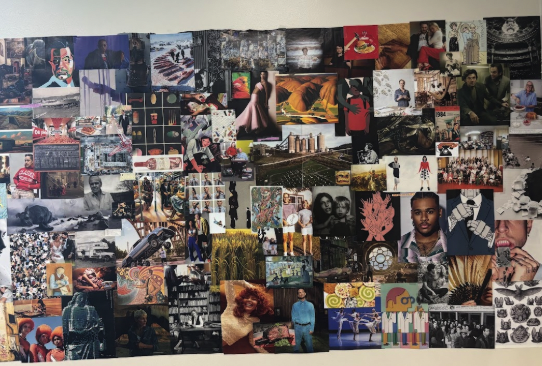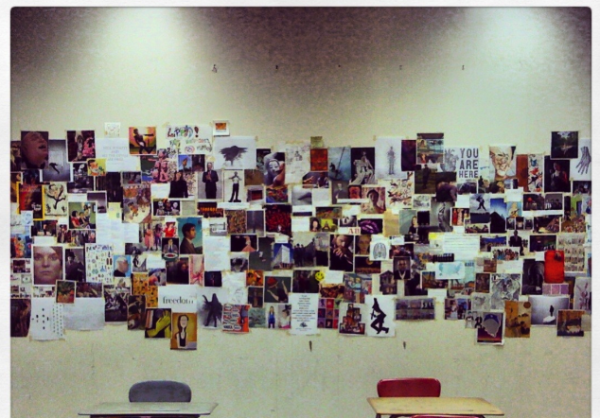

Mr. Brody Lipton’s classroom has windows, desks, and chairs, but what most students notice first are the hundreds of pictures covering the walls. Covered in images carefully hand-picked by Lipton, the room invites students to look closely and think deeply. For almost his entire teaching career of seventeen years, Lipton has been crafting his walls of images. While the pictures themselves change from year to year, the idea behind them remains consistent.
Rather than offering a fixed message, the walls invite students to interpret, question, and connect the images to the ideas discussed in their English class. Many students treat the walls as a puzzle or guessing game, trying to decode the pictures’ meanings or what they represent. Lipton, however, encourages a different approach.
“It’s more about understanding it,” he said. “People run into trouble when they assume it’s about guessing.” He believes the walls reflect the work students do in English class, where meaning comes from close reading and critical thinking, rather than quick conclusions.
According to Lipton, understanding the walls cannot happen all at once. He believes the meaning becomes clearer over time, especially when students return to visit the classroom years later.
“You have to see the wall one year, and then see it again another year,” he said. Each experience adds context and depth.
That process reflects the goal of Lipton’s English class.
Students notice the impact of the wall too. Senior Jack Lane, who had Lipton for two years, reflected on the impact of the pictures in English class. “At first, I didn’t think much of it. I thought it was an interesting part of the decor. But at the end of the year, he tells us that we need to, like, memorize the pictures and go find and label all the pictures,” Lane said about his first experience with Lipton. “After doing that last year, I’ve learned to try to take in what the pictures are saying, ’cause each picture has a meaning. Each person in the picture has a different emotion. Each picture is from a different time frame.”
Over time, students may begin to see the pictures differently, noticing connections that they missed before. In that way, the wall becomes more than a backdrop. It becomes a quiet reminder that learning is not about finding the answers, but about growth and the willingness to return and look again.