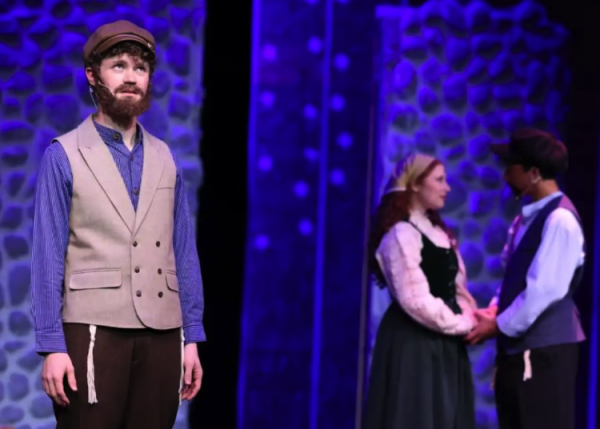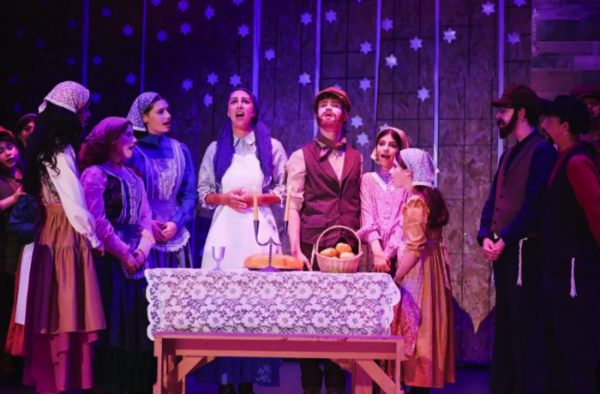
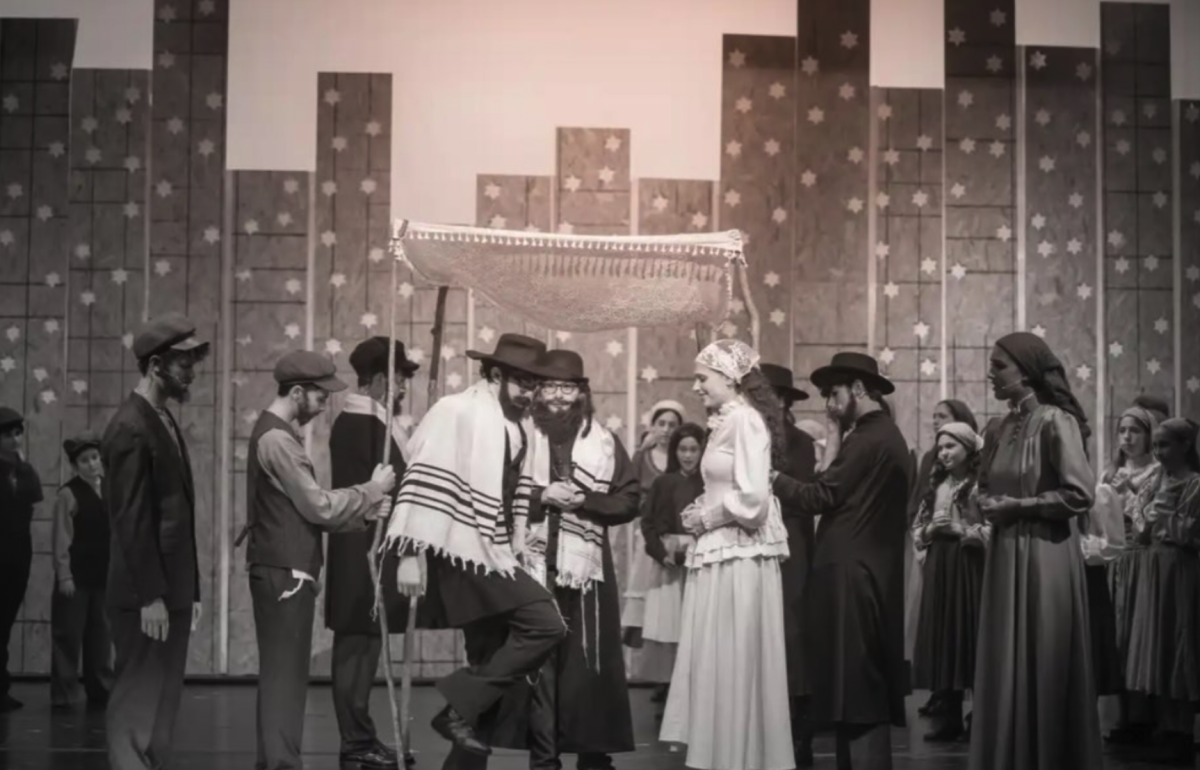
You walk into the Becker Theater after school, and you see students from across the middle and upper school dancing across a star-studded set. You see boys wearing long beards and tzitzit, and girls wearing long wigs and dresses. A chuppah rests on the stage with performers under it, cheering and clapping all around. The sounds of rich harmonies fill your ears. What could this possibly be?
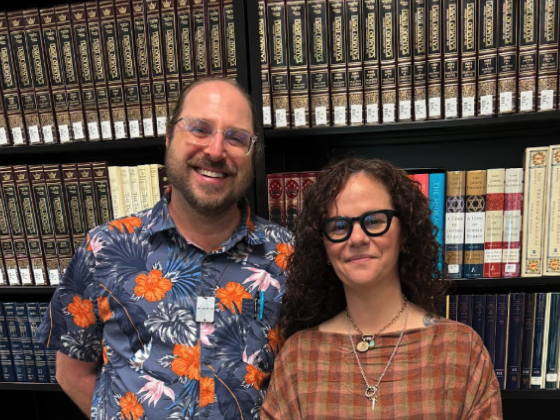
The One School Musical this year is “Fiddler on the Roof,” with performances on April 24, 26, and 27. This show is special to the Emery/Weiner community because it is infused with Jewish culture and history. In order to find out all of the important historical background relevant to the show, I talked with Rachel Silton, Upper School Judaic Studies Teacher, who not only loves the show but also understands its intricate historical context.
Silton explained the complexity of Jewish life in the Soviet Union during the early 1900s, specifically 1905 when the show is set. It was a difficult time for Jews, most of them living in shtetls, which were small predominantly Jewish towns in Eastern Europe that existed from the 16th century to the holocaust. The show explores what life was like for Ashkenazi Jews during the rise of antisemitism, leading up to the Russian Revolution, which sparked debate within these communities about Jewish integration into Russian society.
“Jews were living in a precarious situation,” Silton said. “Some of them wanted to integrate into mainstream society, while also feeling this tension of keeping their differences and maintaining their Jewishness, and there was a push back and feeling like you couldn’t maintain your identity if you integrated.”
She then went on to explain how many governing bodies during the time were not allowing Jews to fully integrate into society, keeping them separate from other people. These tensions between integration and isolation, as well as between open-mindedness or progressivism and maintaining traditional values, play out throughout the show.
It is important to understand “what’s going on in traditional shtetl life, and the kind of forces that are pulling people out and the forces that are keeping people in,” Silton explained.
The show illustrates the pressures that were influencing Jews in Russia during the 1900s by focusing on the different relationships the Tevye’s daughters form and the men they desire to marry. Tevye is the main character of the show and a poor milkman who has five daughters. The first one is Tzeitel, his oldest daughter, who rejects the marriage set up for her by a matchmaker in order to marry a poor tailor named Motel, whom she loves.
“Tzeitel wanted a love marriage, and even that was pushing a boundary, but it was a boundary that could be pushed because he’s Jewish,” Silton explained. Tevye allows for their marriage, but an important part of the reason he agreed is that “they’re more comfortable with that insular nature of the shtetl; it feels like home to them,” Silton said. “They don’t have a desire to branch out.”
The desire to leave becomes more prevalent with Tevye’s second daughter, Hodel, who marries an intellectual named Perchick. Unconventionally, they do not ask for his permission to marry, only his blessing. Later in the show, she leaves Anatevka, the fictional town they live in, to move to Siberia with her husband, and Tevye, while nervous for his daughter, allows this to happen.
“Perchick doesn’t like the insular nature of the shtetl. He wants to branch out. And that’s what they eventually go do,” Silton explained.
After begrudgingly accepting his older daughters, Tevye finally snaps. His third daughter, Chava, falls in love with and marries a Russian soldier named Fyedka. This marriage is a breaking point for Tevye because the Russians have been persecuting and terrorizing the Jews, and Fyedka is outside of the faith. He tells Chava he never wants to see her again and acts as if she is dead to him.
“I think some people might even get offended by this, and it’s not meant to be offensive,” Silton argues. “It’s meant to be reflective of that moment in time, because to survive as Jewish during a time in which they are being actively persecuted, the only thing that they knew to do was to stay insular and to keep their traditions going.”
Next time you walk into the Becker Theater and see students in costume, performing as Russian Jews from the 1900s, remember that they are not only putting on a show, but teaching the audience about an important part of Jewish history.