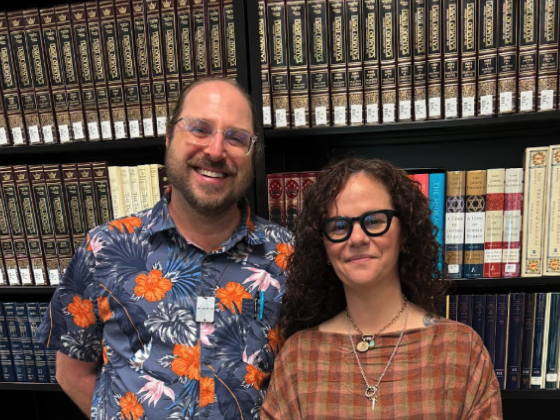
“[It] offers a really unique opportunity for like-minded Jewish teens to connect and not only form new friendships, but also … exercise their minds in really cool and unique way,” says Emery/Weiner senior Gaby Brown. Brown is talking about the Maimonides Moot Court High School Competition. Held annually in the New York-New Jersey area, the competition brings together around 300 students from the United States, Canada, Argentina, and Israel to compete in Moot Beit Din.
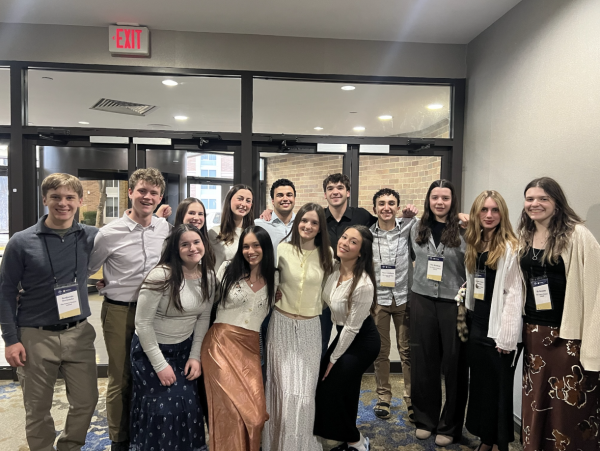
In the words of Brown, Moot Beit Din is “a Jewish organization where Jewish teens apply Jewish legal principles and rabbinical text to contemporary cases and use the Talmud and Talmudic sources to construct an argument for a contemporary case.” This year, Emery/Weiner sent 14 students to compete, one of the largest delegations the school has ever sent.
The topic of this year’s conference, taking place March 19-22, was pediatric organ donation. The goal of the teams was to formulate, present, and argue a case on the topic centered around Jewish law and text. “Obviously [organ donation wasn’t a] thing way back [when the Talmud was written] but we have to take those principles and apply them to modern cases,” Brown adds, clarifying the primary challenge of Moot Court: applying ancient ideas to modern situations. In order to fully equip themselves for that challenge, the team undergoes intense preparation in the months leading up to the competition.
Emery’s team received the case around September or October of last year and spent the months leading up to the competition prepping. “We study the source packet, which is usually split into five or six units,” says Brown. “We ask questions … make sure that we understand what the rabbis are arguing, and then later … we’ll start formulating our arguments, making a source tracker, and … compiling everything together.”
With an in-depth knowledge of the modern-day case and the relevant Jewish law and texts, the team can go to New York fully prepared to confidently present their case. Yet the competition itself is actually a very small part of the entire Moot Court experience. As junior Liana Rosines says, “The most rewarding thing is being able to see where we find unexpected fun.”
This year, prior to the competition, the Emery team spent a day in New York City. “We went to the Tenement Museum … We got to learn about Jewish history. We went to The Pickle Guys and just got to experience the Lower East Side. It was really cool,” says Brown. In order to enrich the Jewish core of the trip, the team was given the chance to experience both traditional, rabbinical Jewish life through the conference and the cultural Jewish life in New York City.

Even upon arriving to the conference, the competition itself does not take place until the end of the weekend. On Saturday, the entire conference spends Shabbat together, having experiences both related to the competition’s topic and broader Jewish life.
Rosines enjoyed “fun rotations relating to the case.” And Brown added that “[they] heard from organ donors [and] a bioethics professor” to add to their knowledge on organ donation and the case’s themes.
Further, they had an opportunity to work with the Gift of Life, an organization dedicated to cell and gene therapy. “We heard from a mother who lost her daughter to leukemia and talked about how she started a separate … chapter of Gift of Life,” Brown says. The conference then allowed anyone 18-years-old or older to swab their cheek and be placed on a registry to give blood or be matched to give a stem cell or bone marrow transplant. Brown found the experience “extremely rewarding” and she “hopes to match someone so that [she] can help save their life.”
There were also rotations focused on the Jewish element of the competition. The attendees were able to hear from various rabbis about their stances and perspectives on these modern cases. “For example, there was a talk about putting … pig parts in human people and [if that is] kosher,” Brown explains. With a wide variety of opportunities and interesting speakers, there was no shortage of knowledge and experience to be passed around.
Finally, the conference performed Shabbat services together and rang in the final night prior to the official competition. “Thursday, Friday, and Saturday [are] literally all about just connecting to your Judaism, connecting with your peers [and] learning. It’s like you … barely even talk about the competition,” Brown says. For both Rosines and Brown, the experience proved educational, inspiring, and served to bring people together, regardless of the competitive atmosphere that would begin on Sunday when the tournament itself would take place.
The competition consists of three divisions, with Emery competing in the middle division, Brandies, which allows them a source packet but no use of outside sources. Each division is then broken into rooms with around six teams each, and then, the teams are scored and ranked via their rooms rather than within the entire division or convention. At the conclusion of the competition, Brown’s team, consisting of herself, senior Emmy Shulman, junior Miriam Cororve, and sophomores Ethan Stulberg and Alexis Brown, placed first in their room. One of Emery’s other teams, freshmen Ava Breston, Ila Breston, and Ainsley Varva-Brown, placed third in their room. These successes prove Emery’s Moot Beit Din is a force to be reckoned with.
Overall, Maimonides Moot Court has given Emery students the chance to think about their Jewish identity in a unique light. “You learn really cool skills about how to apply texts from something so ancient … and showing how the Torah [and] all of those principles can still be applied today,” Brown comments. “In light of all the antisemitism nowadays, any organization that gives Jewish teens the chance to gather together is just so special and important,” she adds.
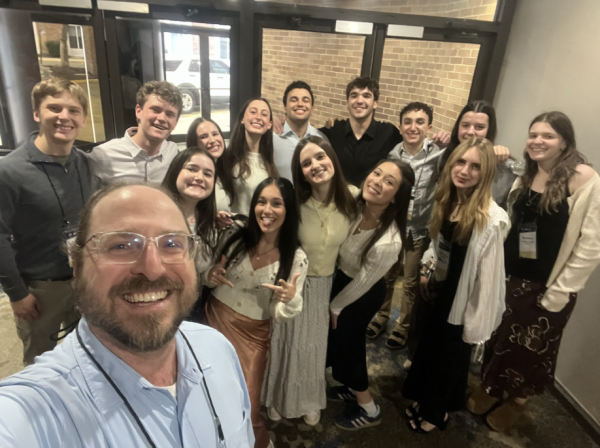
In the past two years, Emery’s team has grown to be almost seven times as big. In 2023 and 2024, Emery only sent three and two students respectively; this year, they sent 14, enough for almost four entire teams. With the team growing so much, now is the time to get involved.
And Brown “100% … [recommends] students getting involved in Moot Beit Din. “Not only is it good for your resume, but it’s also just an incredible experience. I’ve learned so much about how the Torah can be applied to everyday life, and I’ve met so many amazing friends at the competition … I really got more in touch with my Judaism in a really unique way.”
To see more about Emery’s Moot Beit Din team, visit their Instagram, @emerymbd.